
CARTA · 13 SEP 1995 Este fue
Este fue
tu cielo.
Elliptical Galaxy M87
NASA APOD · Anglo-Australian Telescope
Board Explanation: Elliptical galaxy M87 is a type of galaxy that looks much different than our own Milky Way Galaxy. But even for an elliptical galaxy M87 is peculiar.
M87 is much bigger than an average galaxy, appears at the center of a whole cluster of galaxies known as the Virgo Cluster, and shows a very high number of globular clusters. These globular clusters are visible as faint
spots surrounding the bright center of M87. In general, elliptical galaxies
contain similar numbers of stars as spiral galaxies, but are ellipsoidal in
shape (spirals are mostly flat), have no spiral structure, and little gas and dust. This picture is number sixty on a publicly posted list of
images from the Anglo-Australian Telescope (AAT). Tomorrow's picture: The Far Side | Archive | Glossary | Education | About APOD | Astronomy Picture of the Day (TM) is created and copyrighted in 1995 by Robert Nemiroff and Jerry Bonnell who are solely responsible for its content.
MENSAJE CÓSMICO
Elliptical galaxy M87 is much larger than an average galaxy and sits at the center of the Virgo Cluster. It is surrounded by a high number of globular clusters, visible as faint spots. Unlike spiral galaxies, ellipticals generally lack distinct spiral arms and contain older stars.
CRÉDITO
© CON DERECHOS DE AUTOR Anglo-Australian Telescope
Board Explanation: Elliptical galaxy M87 is a type of galaxy that looks much different than our own Milky Way Galaxy. But even for an elliptical galaxy M87 is peculiar.
M87 is much bigger than an average galaxy, appears at the center of a whole cluster of galaxies known as the Virgo Cluster, and shows a very high number of globular clusters. These globular clusters are visible as faint
spots surrounding the bright center of M87. In general, elliptical galaxies
contain similar numbers of stars as spiral galaxies, but are ellipsoidal in
shape (spirals are mostly flat), have no spiral structure, and little gas and dust. This picture is number sixty on a publicly posted list of
images from the Anglo-Australian Telescope (AAT). Tomorrow's picture: The Far Side | Archive | Glossary | Education | About APOD | Astronomy Picture of the Day (TM) is created and copyrighted in 1995 by Robert Nemiroff and Jerry Bonnell who are solely responsible for its content. · used by permission via NASA APOD · no se permite su redistribución. · Ver fuente
EXPORTAR COMO
SB-1995-09-13
©
POCO COMÚN 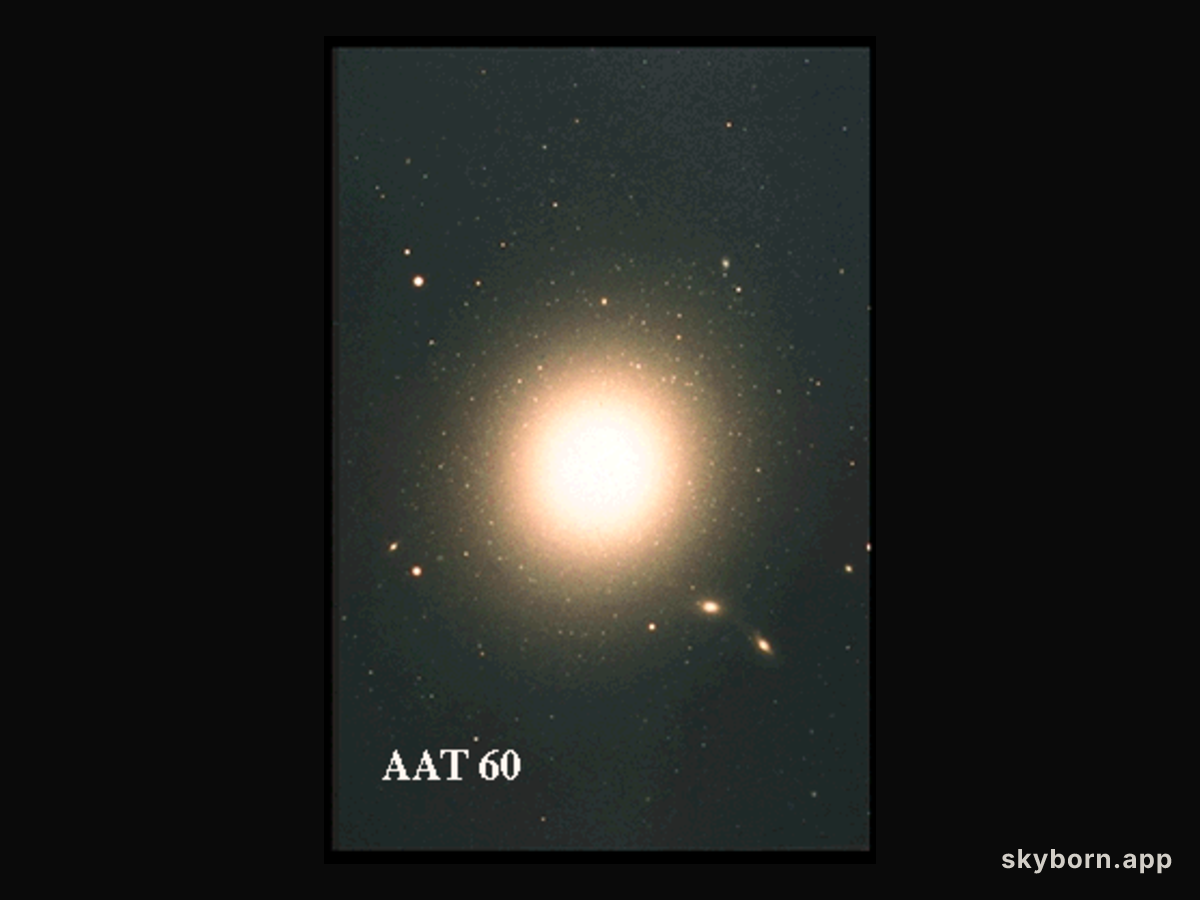

1995-09-13 · ♍
SKYBORN
Elliptical Galaxy M87
NASA APOD · Anglo-Australian Telescope
Board Explanation: Elliptical galaxy M87 is a type of galaxy that looks much different than our own Milky Way Galaxy. But even for an elliptical galaxy M87 is peculiar.
M87 is much bigger than an average galaxy, appears at the center of a whole cluster of galaxies known as the Virgo Cluster, and shows a very high number of globular clusters. These globular clusters are visible as faint
spots surrounding the bright center of M87. In general, elliptical galaxies
contain similar numbers of stars as spiral galaxies, but are ellipsoidal in
shape (spirals are mostly flat), have no spiral structure, and little gas and dust. This picture is number sixty on a publicly posted list of
images from the Anglo-Australian Telescope (AAT). Tomorrow's picture: The Far Side | Archive | Glossary | Education | About APOD | Astronomy Picture of the Day (TM) is created and copyrighted in 1995 by Robert Nemiroff and Jerry Bonnell who are solely responsible for its content.
NACIDO hace 11.354 días
SKYBORN.APP
CONTEXTO ZODIACAL
♍
VIRGO
En la astrología tropical, el 13 SEP 1995 cae bajo Virgo (♍). La ventana del signo va del 23 AGO al 22 SEP. Virgo es la constelación zodiacal más grande y contiene el corazón del cúmulo de galaxias de Virgo. El Sol cruzaba esta región del cielo el 13 SEP 1995.
EL ALMANAQUE DEL 13 SEP 1995
DÍA
Miércoles
LUNA
Gibosa menguante, 86% de iluminación
POSICIÓN
Día 256 de 365
MISMO DÍA, OTROS AÑOS