
PULL · 19 SEP 1995 This was
This was
your sky.
The Small Cloud of Magellan
NASA APOD · Anglo-Australian Telescope
Board Explanation: Almost unknown to casual observers in the northern hemisphere,
the southern
sky contains two diffuse wonders known as the
Magellanic Clouds.
The Magellanic Clouds are small irregular
galaxies orbiting our
own larger Milky Way spiral galaxy.
The Small Magellanic Cloud
(SMC), pictured here,
is about 250,000 light years away and
contains a preponderance of young, hot, blue stars indicating it has
undergone a recent period of star formation.
There is evidence that the SMC is actually two
galaxies superposed to appear as one. The bright blob near
the right hand edge of the frame is a
globular cluster near the
outskirts of the Milky Way. Tomorrow's picture: GL 105C: The Coolest Star? | Archive | Glossary | Education | About APOD | Astronomy Picture of the Day (APOD) is created and edited in 1995 by
Robert
Nemiroff (GMU) and
Jerry Bonnell (USRA). Specific rights may apply.
Correspondence about APOD should be addressed to
nemiroff@grossc.gsfc.nasa.gov or bonnell@grossc.gsfc.nasa.gov. A service of the Laboratory for High Energy Astrophysics (LHEA) at
NASA/
GSFC Technical Rep:
Sherri Calvo,
301-286-5668, sherri.calvo@gsfc.nasa.gov
Questions/Comments/Feedback to: feedback@athena.gsfc.nasa.gov General astronomy pointers are available.
COSMIC MESSAGE
The Small Magellanic Cloud is a dwarf irregular galaxy, a satellite of our Milky Way. It is about 250,000 light years away. This galaxy is rich in young, hot, blue stars, indicating a recent burst of star formation. It is nearly invisible from the northern hemisphere, but a prominent sight in the southern sky.
CREDIT
© COPYRIGHTED Anglo-Australian Telescope
Board Explanation: Almost unknown to casual observers in the northern hemisphere,
the southern
sky contains two diffuse wonders known as the
Magellanic Clouds.
The Magellanic Clouds are small irregular
galaxies orbiting our
own larger Milky Way spiral galaxy.
The Small Magellanic Cloud
(SMC), pictured here,
is about 250,000 light years away and
contains a preponderance of young, hot, blue stars indicating it has
undergone a recent period of star formation.
There is evidence that the SMC is actually two
galaxies superposed to appear as one. The bright blob near
the right hand edge of the frame is a
globular cluster near the
outskirts of the Milky Way. Tomorrow's picture: GL 105C: The Coolest Star? | Archive | Glossary | Education | About APOD | Astronomy Picture of the Day (APOD) is created and edited in 1995 by
Robert
Nemiroff (GMU) and
Jerry Bonnell (USRA). Specific rights may apply.
Correspondence about APOD should be addressed to
nemiroff@grossc.gsfc.nasa.gov or bonnell@grossc.gsfc.nasa.gov. A service of the Laboratory for High Energy Astrophysics (LHEA) at
NASA/
GSFC Technical Rep:
Sherri Calvo,
301-286-5668, sherri.calvo@gsfc.nasa.gov
Questions/Comments/Feedback to: feedback@athena.gsfc.nasa.gov General astronomy pointers are available. · Anglo-Australian Telescope
Board Explanation: Almost unknown to casual observers in the northern hemisphere,
the southern
sky contains two diffuse wonders known as the
Magellanic Clouds.
The Magellanic Clouds are small irregular
galaxies orbiting our
own larger Milky Way spiral galaxy.
The Small Magellanic Cloud
(SMC), pictured here,
is about 250,000 light years away and
contains a preponderance of young, hot, blue stars indicating it has
undergone a recent period of star formation.
There is evidence that the SMC is actually two
galaxies superposed to appear as one. The bright blob near
the right hand edge of the frame is a
globular cluster near the
outskirts of the Milky Way. Tomorrow's picture: GL 105C: The Coolest Star? | Archive | Glossary | Education | About APOD | Astronomy Picture of the Day (APOD) is created and edited in 1995 by
Robert
Nemiroff (GMU) and
Jerry Bonnell (USRA). Specific rights may apply.
Correspondence about APOD should be addressed to
nemiroff@grossc.gsfc.nasa.gov or bonnell@grossc.gsfc.nasa.gov. A service of the Laboratory for High Energy Astrophysics (LHEA) at
NASA/
GSFC Technical Rep:
Sherri Calvo,
301-286-5668, sherri.calvo@gsfc.nasa.gov
Questions/Comments/Feedback to: feedback@athena.gsfc.nasa.gov General astronomy pointers are available. · used by permission via NASA APOD · not for redistribution. · View source
EXPORT AS
SB-1995-09-19
©
UNCOMMON 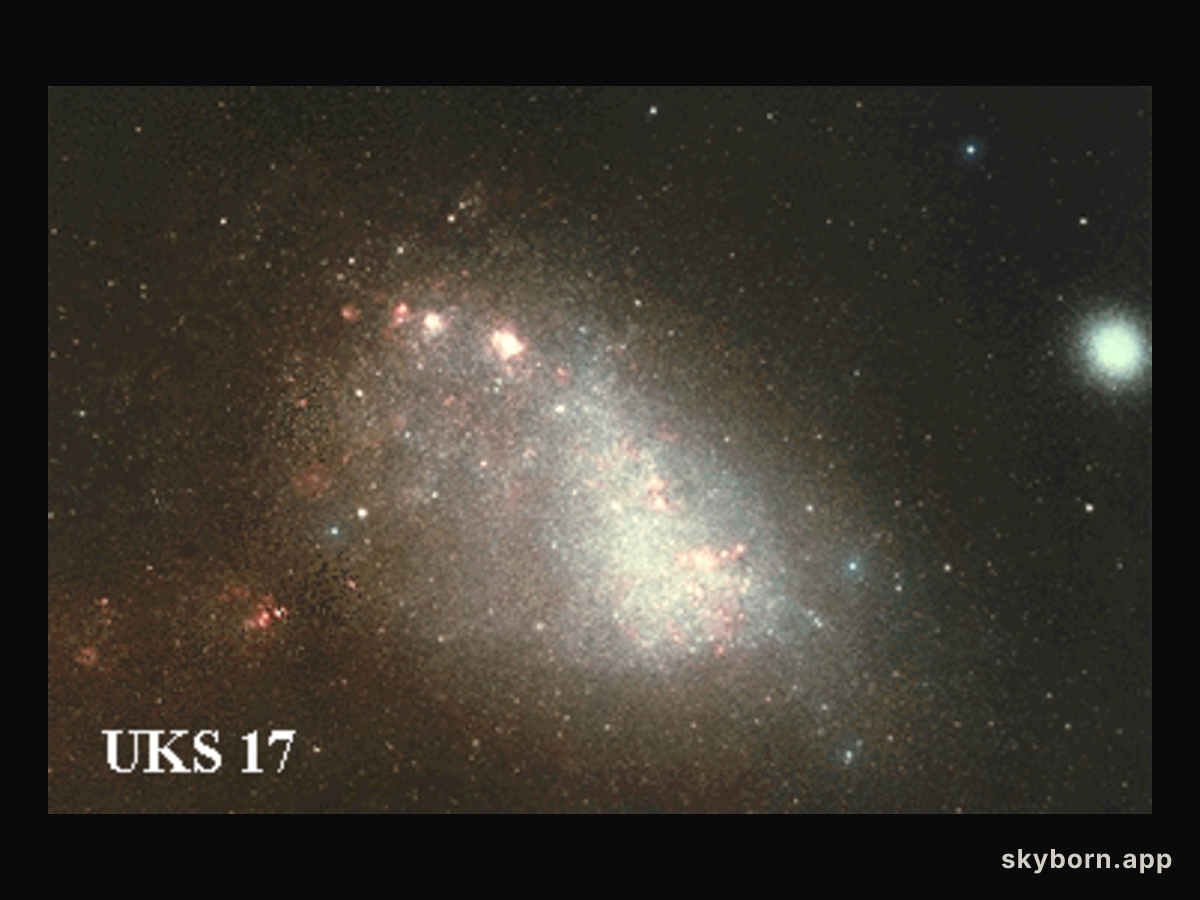

1995-09-19 · ♍
SKYBORN
The Small Cloud of Magellan
NASA APOD · Anglo-Australian Telescope
Board Explanation: Almost unknown to casual observers in the northern hemisphere,
the southern
sky contains two diffuse wonders known as the
Magellanic Clouds.
The Magellanic Clouds are small irregular
galaxies orbiting our
own larger Milky Way spiral galaxy.
The Small Magellanic Cloud
(SMC), pictured here,
is about 250,000 light years away and
contains a preponderance of young, hot, blue stars indicating it has
undergone a recent period of star formation.
There is evidence that the SMC is actually two
galaxies superposed to appear as one. The bright blob near
the right hand edge of the frame is a
globular cluster near the
outskirts of the Milky Way. Tomorrow's picture: GL 105C: The Coolest Star? | Archive | Glossary | Education | About APOD | Astronomy Picture of the Day (APOD) is created and edited in 1995 by
Robert
Nemiroff (GMU) and
Jerry Bonnell (USRA). Specific rights may apply.
Correspondence about APOD should be addressed to
nemiroff@grossc.gsfc.nasa.gov or bonnell@grossc.gsfc.nasa.gov. A service of the Laboratory for High Energy Astrophysics (LHEA) at
NASA/
GSFC Technical Rep:
Sherri Calvo,
301-286-5668, sherri.calvo@gsfc.nasa.gov
Questions/Comments/Feedback to: feedback@athena.gsfc.nasa.gov General astronomy pointers are available.
BORN 11331 days ago
SKYBORN.APP
ZODIAC CONTEXT
♍
VIRGO
In tropical astrology, 19 SEP 1995 falls under Virgo (♍). The sign's window runs from 08-23 through 09-22. Virgo is the largest zodiac constellation, holding the heart of the Virgo galaxy cluster. The Sun was crossing this region of the sky on 19 SEP 1995.
THE ALMANAC FOR 19 SEP 1995
DAY
Tuesday
MOON
Waning crescent, 27% lit
POSITION
Day 262 of 365
SAME DAY, OTHER YEARS