
PULL · 18 SEP 1995 This was
This was
your sky.
The Large Cloud of Magellan
NASA APOD · Anglo-Australian Telescope
Board Explanation: Magellan and his crew had plenty of time to study the southern sky
during their famous voyage around the world. As a result, two fuzzy
cloud like objects, nestled among the southern constellations of Doradus
and Tucana are now
known as the Clouds of Magellan. The Magellanic Clouds are small irregular
galaxies, satellites of our
larger Milky Way spiral galaxy.
The Large Magellanic Cloud
(LMC) pictured above is the closest galaxy to our own Milky Way,
at a distance of about 180,000 light years.
The Magellanic Clouds are joined to the Milky Way by a
stream of cold hydrogen gas whose origin is still controversial.
An unusual effect called
gravitational lensing has recently
been detected in a few LMC stars, and there is hope this could
tell us important information about the
true composition of our universe. Tomorrow's picture: The Small Cloud of Magellan | Archive | Glossary | Education | About APOD | Astronomy Picture of the Day (TM) is created and copyrighted in 1995 by Robert Nemiroff and Jerry Bonnell who are solely responsible for its content.
COSMIC MESSAGE
The Large Magellanic Cloud is a dwarf irregular galaxy, the closest galaxy to our Milky Way at about 180,000 light years. It is a satellite of our galaxy. The LMC is a striking feature in the southern night sky, visible to the unaided eye. It sits among the southern constellations of Doradus and Tucana.
CREDIT
© COPYRIGHTED Anglo-Australian Telescope
Board Explanation: Magellan and his crew had plenty of time to study the southern sky
during their famous voyage around the world. As a result, two fuzzy
cloud like objects, nestled among the southern constellations of Doradus
and Tucana are now
known as the Clouds of Magellan. The Magellanic Clouds are small irregular
galaxies, satellites of our
larger Milky Way spiral galaxy.
The Large Magellanic Cloud
(LMC) pictured above is the closest galaxy to our own Milky Way,
at a distance of about 180,000 light years.
The Magellanic Clouds are joined to the Milky Way by a
stream of cold hydrogen gas whose origin is still controversial.
An unusual effect called
gravitational lensing has recently
been detected in a few LMC stars, and there is hope this could
tell us important information about the
true composition of our universe. Tomorrow's picture: The Small Cloud of Magellan | Archive | Glossary | Education | About APOD | Astronomy Picture of the Day (TM) is created and copyrighted in 1995 by Robert Nemiroff and Jerry Bonnell who are solely responsible for its content. · Anglo-Australian Telescope
Board Explanation: Magellan and his crew had plenty of time to study the southern sky
during their famous voyage around the world. As a result, two fuzzy
cloud like objects, nestled among the southern constellations of Doradus
and Tucana are now
known as the Clouds of Magellan. The Magellanic Clouds are small irregular
galaxies, satellites of our
larger Milky Way spiral galaxy.
The Large Magellanic Cloud
(LMC) pictured above is the closest galaxy to our own Milky Way,
at a distance of about 180,000 light years.
The Magellanic Clouds are joined to the Milky Way by a
stream of cold hydrogen gas whose origin is still controversial.
An unusual effect called
gravitational lensing has recently
been detected in a few LMC stars, and there is hope this could
tell us important information about the
true composition of our universe. Tomorrow's picture: The Small Cloud of Magellan | Archive | Glossary | Education | About APOD | Astronomy Picture of the Day (TM) is created and copyrighted in 1995 by Robert Nemiroff and Jerry Bonnell who are solely responsible for its content. · used by permission via NASA APOD · not for redistribution. · View source
EXPORT AS
SB-1995-09-18
©
UNCOMMON 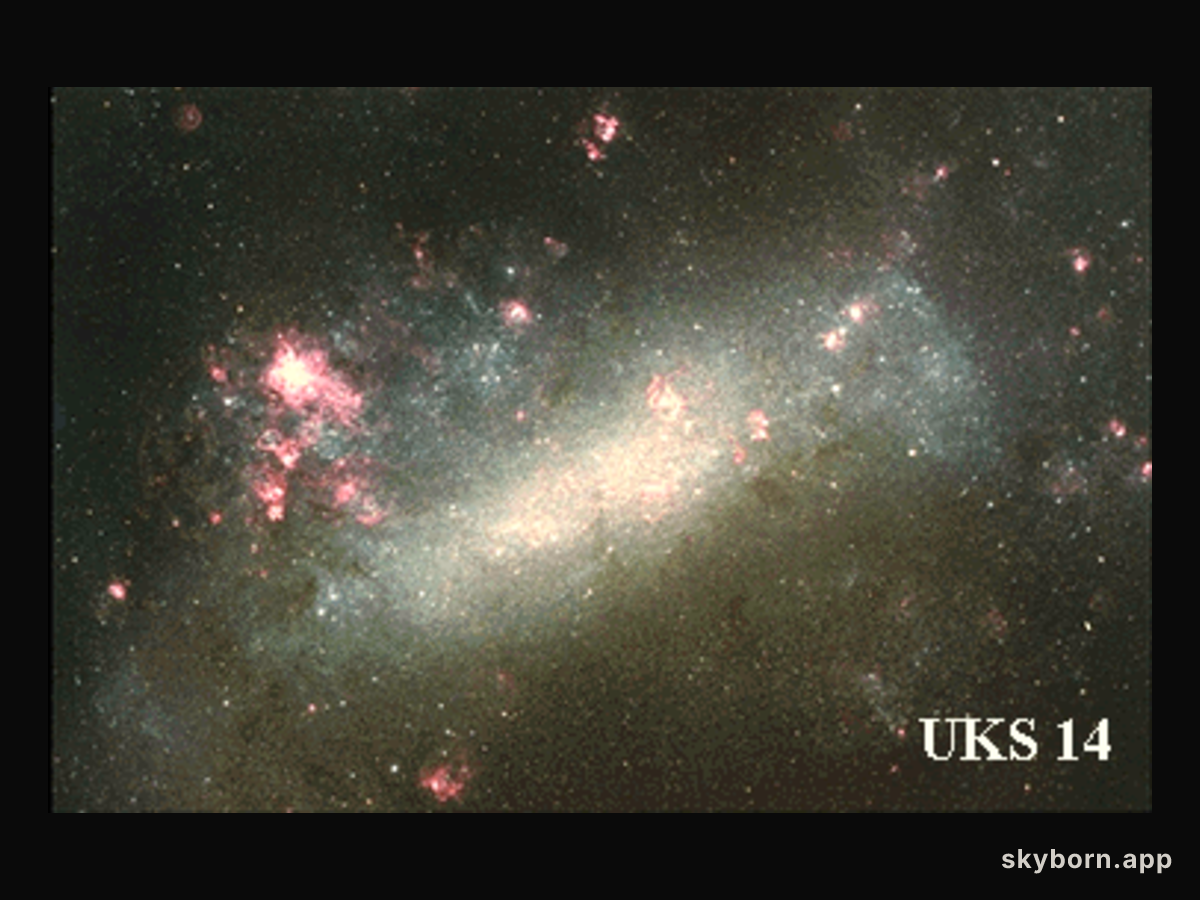

1995-09-18 · ♍
SKYBORN
The Large Cloud of Magellan
NASA APOD · Anglo-Australian Telescope
Board Explanation: Magellan and his crew had plenty of time to study the southern sky
during their famous voyage around the world. As a result, two fuzzy
cloud like objects, nestled among the southern constellations of Doradus
and Tucana are now
known as the Clouds of Magellan. The Magellanic Clouds are small irregular
galaxies, satellites of our
larger Milky Way spiral galaxy.
The Large Magellanic Cloud
(LMC) pictured above is the closest galaxy to our own Milky Way,
at a distance of about 180,000 light years.
The Magellanic Clouds are joined to the Milky Way by a
stream of cold hydrogen gas whose origin is still controversial.
An unusual effect called
gravitational lensing has recently
been detected in a few LMC stars, and there is hope this could
tell us important information about the
true composition of our universe. Tomorrow's picture: The Small Cloud of Magellan | Archive | Glossary | Education | About APOD | Astronomy Picture of the Day (TM) is created and copyrighted in 1995 by Robert Nemiroff and Jerry Bonnell who are solely responsible for its content.
BORN 11332 days ago
SKYBORN.APP
ZODIAC CONTEXT
♍
VIRGO
In tropical astrology, 18 SEP 1995 falls under Virgo (♍). The sign's window runs from 08-23 through 09-22. Virgo is the largest zodiac constellation, holding the heart of the Virgo galaxy cluster. The Sun was crossing this region of the sky on 18 SEP 1995.
THE ALMANAC FOR 18 SEP 1995
DAY
Monday
MOON
Last quarter, 37% lit
POSITION
Day 261 of 365
SAME DAY, OTHER YEARS