
PULL · 3 JAN 1997 This was
This was
your sky.
A Wolf-Rayet Star Blows Bubbles
NASA APOD · P. Berlind & P. Challis (CfA), 1.2-m Telescope, Whipple Obs.
COSMIC MESSAGE
Wolf-Rayet stars are exceptionally hot and luminous, shedding their outer layers as a powerful stellar wind. This process creates the 'bubbles' of gas seen around them. These massive stars, about 200 of which are known in our galaxy, lose more than an Earth's mass each year through these winds. They represent a late stage in the evolution of the most massive stars.
CREDIT
© COPYRIGHTED P. Berlind & P. Challis (CfA), 1.2-m Telescope, Whipple Obs. · P. Berlind & P. Challis (CfA), 1.2-m Telescope, Whipple Obs. · used by permission via NASA APOD · not for redistribution. · View source
EXPORT AS
SB-1997-01-03
©
RARE · HOLO 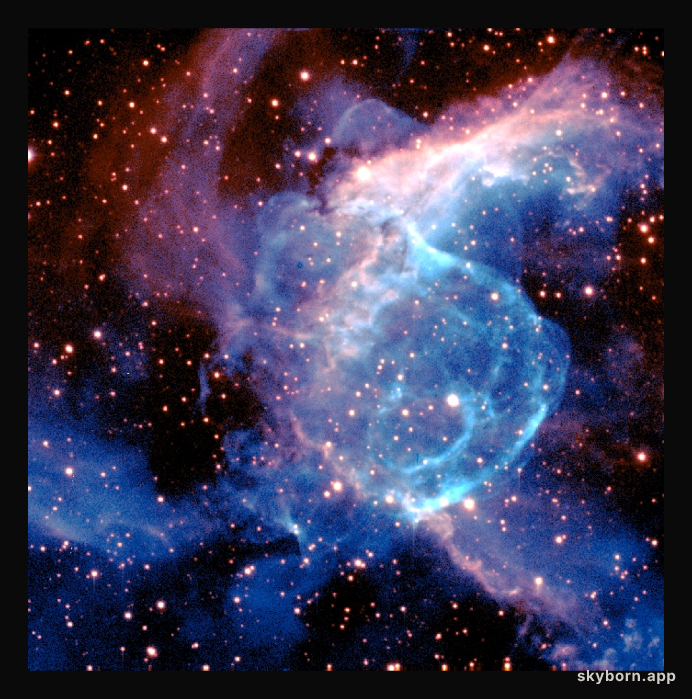

1997-01-03 · ♑
SKYBORN
A Wolf-Rayet Star Blows Bubbles
NASA APOD · P. Berlind & P. Challis (CfA), 1.2-m Telescope, Whipple Obs.
BORN 10859 days ago
SKYBORN.APP
ZODIAC CONTEXT
♑
CAPRICORN
In tropical astrology, 3 JAN 1997 falls under Capricorn (♑). The sign's window runs from 12-22 through 01-19. Capricorn is the dimmest zodiac constellation, but rich in deep-sky objects south of the celestial equator. The Sun was crossing this region of the sky on 3 JAN 1997.
THE ALMANAC FOR 3 JAN 1997
DAY
Friday
MOON
Last quarter, 32% lit
POSITION
Day 3 of 365
METEOR SHOWER
Quadrantid shower, peaks tomorrow
SAME DAY, OTHER YEARS