
PULL · 17 SEP 1995 This was
This was
your sky.
Thousands of Coma Cluster Galaxies
NASA APOD · Royal Observatory Edinburgh, Anglo-Australian Observatory, and AURA Explanation: Almost every object in the above photograph is a galaxy. The Coma Cluster of galaxies pictured is a dense cluster containing many thousands of galaxies. Many of these galaxies contain as many stars as our own Milky Way Galaxy. Although nearby when compared to most other clusters, light from the Coma Cluster
still takes hundreds of millions of years to reach us. In
fact, the Coma Cluster is so big it takes light millions of years just to
go from one side to the other! This picture was created at the WWW site
Skyview, a "virtual observatory" where it is possible to view any part of
the sky in wavelengths from radio to gamma-ray. Tomorrow's picture: The Large Cloud of Magellan | Archive | Glossary | Education | About APOD | Astronomy Picture of the Day (TM) is created and copyrighted in 1995 by Robert Nemiroff and Jerry Bonnell who are solely responsible for its content.
COSMIC MESSAGE
Almost every point of light in this image is a galaxy. This is the Coma Cluster, a dense collection of thousands of galaxies. Many of these galaxies contain as many stars as our own Milky Way. Light from the Coma Cluster takes hundreds of millions of years to reach us.
CREDIT
© COPYRIGHTED Royal Observatory Edinburgh, Anglo-Australian Observatory, and AURA Explanation: Almost every object in the above photograph is a galaxy. The Coma Cluster of galaxies pictured is a dense cluster containing many thousands of galaxies. Many of these galaxies contain as many stars as our own Milky Way Galaxy. Although nearby when compared to most other clusters, light from the Coma Cluster
still takes hundreds of millions of years to reach us. In
fact, the Coma Cluster is so big it takes light millions of years just to
go from one side to the other! This picture was created at the WWW site
Skyview, a "virtual observatory" where it is possible to view any part of
the sky in wavelengths from radio to gamma-ray. Tomorrow's picture: The Large Cloud of Magellan | Archive | Glossary | Education | About APOD | Astronomy Picture of the Day (TM) is created and copyrighted in 1995 by Robert Nemiroff and Jerry Bonnell who are solely responsible for its content. · Royal Observatory Edinburgh, Anglo-Australian Observatory, and AURA Explanation: Almost every object in the above photograph is a galaxy. The Coma Cluster of galaxies pictured is a dense cluster containing many thousands of galaxies. Many of these galaxies contain as many stars as our own Milky Way Galaxy. Although nearby when compared to most other clusters, light from the Coma Cluster
still takes hundreds of millions of years to reach us. In
fact, the Coma Cluster is so big it takes light millions of years just to
go from one side to the other! This picture was created at the WWW site
Skyview, a "virtual observatory" where it is possible to view any part of
the sky in wavelengths from radio to gamma-ray. Tomorrow's picture: The Large Cloud of Magellan | Archive | Glossary | Education | About APOD | Astronomy Picture of the Day (TM) is created and copyrighted in 1995 by Robert Nemiroff and Jerry Bonnell who are solely responsible for its content. · used by permission via NASA APOD · not for redistribution. · View source
EXPORT AS
SB-1995-09-17
©
UNCOMMON 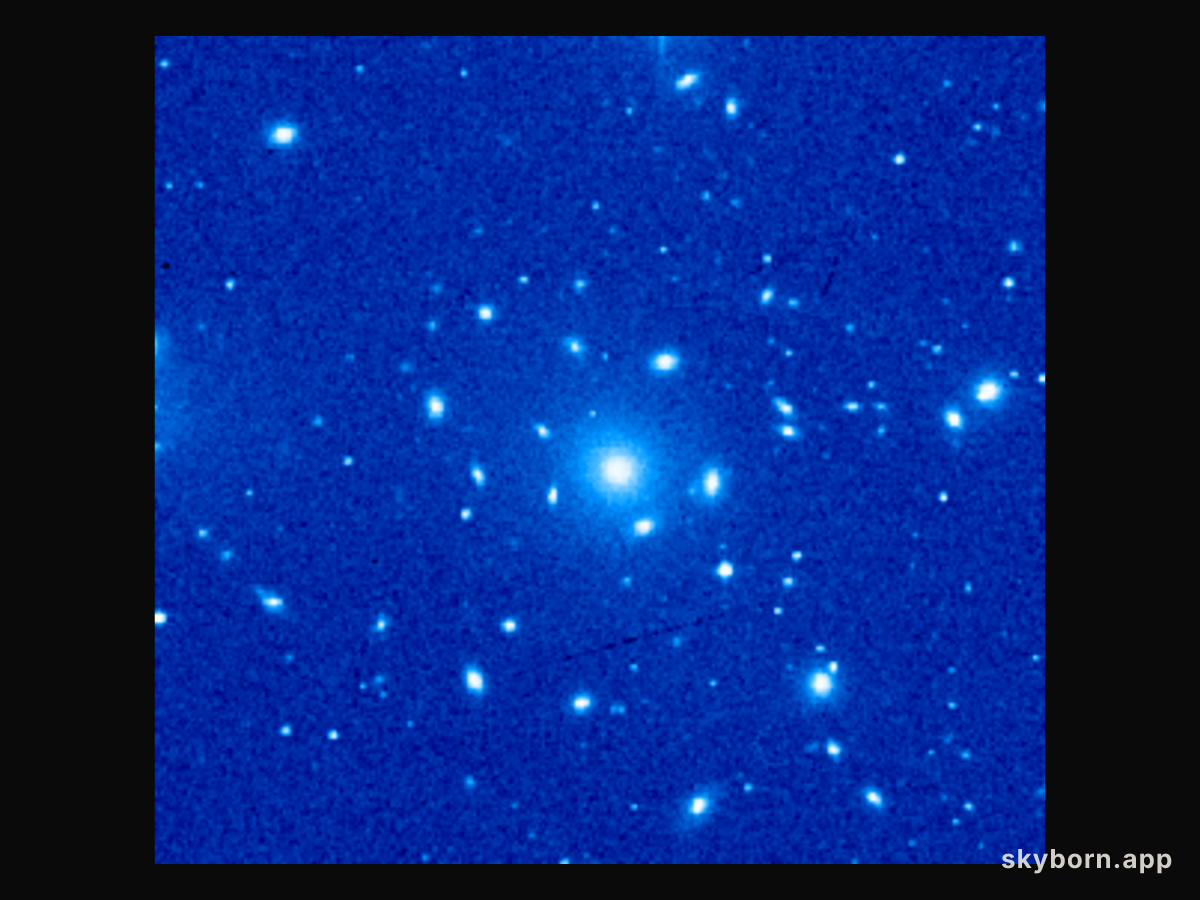

1995-09-17 · ♍
SKYBORN
Thousands of Coma Cluster Galaxies
NASA APOD · Royal Observatory Edinburgh, Anglo-Australian Observatory, and AURA Explanation: Almost every object in the above photograph is a galaxy. The Coma Cluster of galaxies pictured is a dense cluster containing many thousands of galaxies. Many of these galaxies contain as many stars as our own Milky Way Galaxy. Although nearby when compared to most other clusters, light from the Coma Cluster
still takes hundreds of millions of years to reach us. In
fact, the Coma Cluster is so big it takes light millions of years just to
go from one side to the other! This picture was created at the WWW site
Skyview, a "virtual observatory" where it is possible to view any part of
the sky in wavelengths from radio to gamma-ray. Tomorrow's picture: The Large Cloud of Magellan | Archive | Glossary | Education | About APOD | Astronomy Picture of the Day (TM) is created and copyrighted in 1995 by Robert Nemiroff and Jerry Bonnell who are solely responsible for its content.
BORN 11333 days ago
SKYBORN.APP
ZODIAC CONTEXT
♍
VIRGO
In tropical astrology, 17 SEP 1995 falls under Virgo (♍). The sign's window runs from 08-23 through 09-22. Virgo is the largest zodiac constellation, holding the heart of the Virgo galaxy cluster. The Sun was crossing this region of the sky on 17 SEP 1995.
THE ALMANAC FOR 17 SEP 1995
DAY
Sunday
MOON
Last quarter, 47% lit
POSITION
Day 260 of 365
SAME DAY, OTHER YEARS