
PULL · 2 JAN 2013 This was
This was
your sky.
The Einstein Cross Gravitational Lens
NASA APOD · J. Rhoads
(Arizona State U.) et al.,
WIYN,
AURA,
NOAO,
NSF
COSMIC MESSAGE
This isn't a galaxy with four nuclei. It's a quasar, a very distant and bright object, whose light is bent by the gravity of a foreground galaxy. The galaxy acts like a lens, splitting the quasar's light into four distinct images. This phenomenon is called a gravitational lens, or an Einstein Cross.
CREDIT
© COPYRIGHTED J. Rhoads
(Arizona State U.) et al.,
WIYN,
AURA,
NOAO,
NSF · J. Rhoads
(Arizona State U.) et al.,
WIYN,
AURA,
NOAO,
NSF · used by permission via NASA APOD · not for redistribution. · View source
EXPORT AS
SB-2013-01-02
©
UNCOMMON 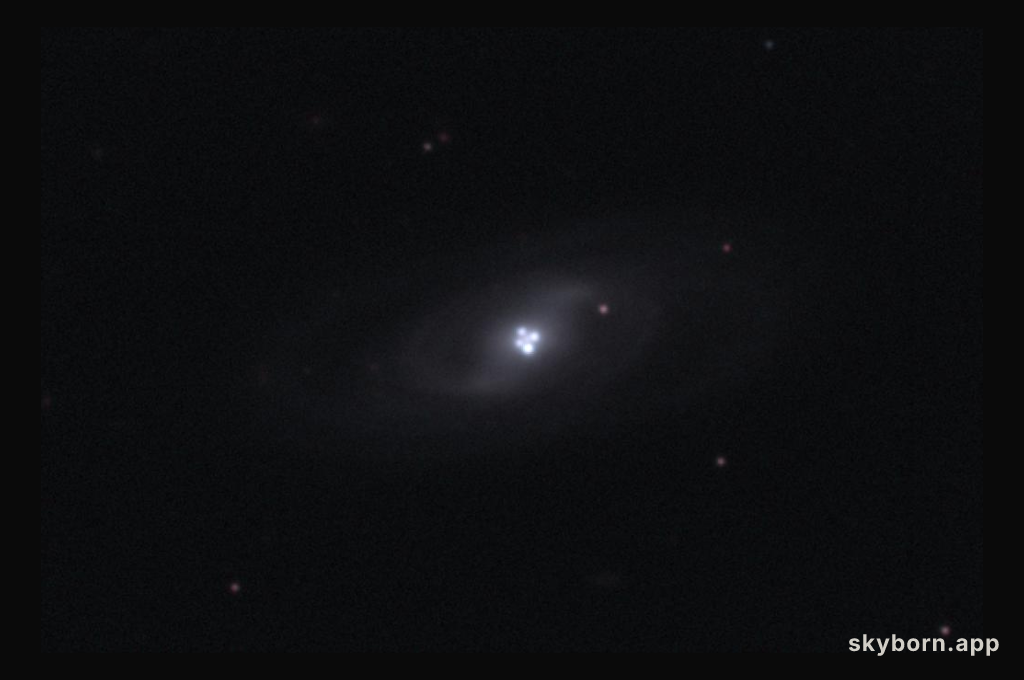

2013-01-02 · ♑
SKYBORN
The Einstein Cross Gravitational Lens
NASA APOD · J. Rhoads
(Arizona State U.) et al.,
WIYN,
AURA,
NOAO,
NSF
BORN 5016 days ago
SKYBORN.APP
ZODIAC CONTEXT
♑
CAPRICORN
In tropical astrology, 2 JAN 2013 falls under Capricorn (♑). The sign's window runs from 12-22 through 01-19. Capricorn is the dimmest zodiac constellation, but rich in deep-sky objects south of the celestial equator. The Sun was crossing this region of the sky on 2 JAN 2013.
THE ALMANAC FOR 2 JAN 2013
DAY
Wednesday
MOON
Waning gibbous, 74% lit
POSITION
Day 2 of 365
METEOR SHOWER
Quadrantid shower, peaks in 2 days
SAME DAY, OTHER YEARS